
Operating margins have been the primary driver of corporate earnings in India in recent quarters, despite revenue growth suffering from weak consumer demand. Companies across sectors have reported a sharp improvement in earnings before interest, tax, depreciation, and amortisation (Ebitda) margins over the past two years, benefiting from lower commodity and energy prices. Higher margins more than compensated for slower revenue growth, resulting in double-digit growth in net profit for five consecutive quarters.

Passenger vehicle wholesales in India rose by 14.16 per cent in August to 2,15,916 units, driven by pent-up demand, industry body SIAM said on Friday. According to the latest data by the Society of Indian Automobile Manufacturers, passenger vehicle wholesales stood at 1,89,129 units in the same month last year.

Automotive (auto) and auto ancillary stocks have been in the fast lane thus far in 2023-24 (FY24), with the National Stock Exchange Nifty Auto Index surging nearly 27 per cent, outperforming the Nifty50, which has gained roughly 11 per cent during this period. The top-gear performance of auto stocks at the bourses, according to A K Prabhakar, head of research at IDBI Capital, has been triggered by the premiumisation of products across vehicle manufacturers, which has seen vehicle sales remaining relatively stable. "It is not about higher sales figures now, but about premiumisation.

Driven by strong demand, the overall passenger vehicle dispatches crossed 3.35 lakh units in February as automakers, including Maruti Suzuki India, Hyundai, Tata Motors and Mahindra & Mahindra, reported robust sales during the month. The dispatches of more than 3.35 lakh units last month marked an 11 per cent over February 2022. It was also the highest ever overall wholesales in the month of February. The country's largest carmaker Maruti Suzuki India on Wednesday said its domestic wholesales rose 11 per cent to 155,114 units in February as compared with 140,035 units in the same month last year.
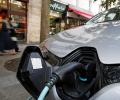
Automobile manufacturers, new and old, as well as ancillary suppliers are set to spend a combined Rs 70,630 crore over the next five years on either entering the electric vehicle segment or stepping up their presence in it. Data culled from announcements made by firms shows India, the world's fifth largest automobile market, is poised to receive one of the biggest capex pushes ever to fuel the transition from internal combustion engines to electric motors and batteries as part of a green drive. The EV push, egged on by the government's emphasis on electric mobility to meet its net zero targets, is expected to yield at least 25 electric vehicles - new ones as well as electrified versions of existing vehicles running on internal combustion engines.

The country's largest carmaker Maruti Suzuki India will not "walk away" and fight to get back to 50 per cent market share in the domestic passenger vehicle segment, according to company Chairman R C Bhargava. The auto major, which is commemorating 40 years of operations, has seen its market share drop to 43.38 per cent in FY22 from a peak of 51.21 per cent in FY19. In order to get back its dominant leadership, the company plans to drive in models catering to both urban and smaller cities and rural areas.

Analysts said the demand recovery in two-wheeler and car segments was skewed towards the semi-urban and rural markets.

On Reva, Mahindra says electric cars are an innovation that can disrupt the automobile sector.

New launches as well as upgrades to existing scooter models marked this year as manufacturers competed with each other to satiate the demand for new and interesting automatic scooters.
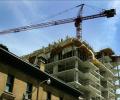
People are not just splurging on clothes, mobiles and household goods through the online route, they are also looking at cars and even houses.

Delhi police sources on Sunday said a team of the crime branch in a joint operation with the Rajasthan police nabbed the duo from Chandigarh's Sector 22.

Local residents say until about two months ago, this board carried the name of Motorola, which once had a manufacturing unit in Sriperumbudur, 40-odd km from Chennai in Tamil Nadu. In May 2020, Luxshare Precision Industry Co, a China-headquartered AirPods and iPhone assembler, had entered into a deal with the Tamil Nadu government to take over the defunct Motorola unit.

Unconventional and still quirky looking as ever, the Mojo gets me thinking of the Predator (from the Arnold Schwarzenegger classic) with hints of Yamah's (bug-eyed) 125cc Fazer and Triumph's Street Triple to stir things up.

Auto sales, particularly of two-wheelers, may not bounce back immediately and may take another two months to come back on track even as car bookings have started seeing an initial uptick. Various states started Unlock 2.0 on Monday, following a fall in the number of Covid-19 cases. Auto sales were hit in May following the impact of Covid-led lockdowns.

This year's edition, three years lost to the pandemic and scheduling, wore a distinctive shade of green, and, as would befit an era of technology shift from internal combustion engines to electric motors, had a clutch of high-technology exhibits and concepts. But the excitement of the expo's heyday was missing.

These commuter bikes, or Aam Aadmi bikes as they are called because of their affordable pricing, were all the rage in 2014.

The group, which aspires to be a significant player in the two-wheeler market, is also working on adding an additional production capacity to meet future targets.

A slew of new products in the mid-segment line-up like Star City Plus and Victor, an agreement with global brand BMW to launch new range of bikes and a strong marketing push is what the Chennai-based automaker has up its sleeves to take on established players in the two-wheeler market.


In the two wheeler segment, TVS Motor Company reported a 24 per cent increase in total sales at 304,795 units in April.

Bhavish Aggarwal, the founder of ride-hailing firm Ola who disrupted the electric scooters market in the country, is planning to launch an electric sports car in 2024. The plan will put it in competition with Indian players, such as the Tata group and Mahindra & Mahindra, and global giants like Tesla and Hyundai. Aggarwal, recently, took a group of reporters to the firm's design studio at the Ola campus in Bengaluru where his teams are working on several EVs, including scooters, motorcycles, sedans, and SUVs - and even robotaxis.
As per SIAM data, vehicle sales across categories, including passenger vehicles and two-wheelers and commercial vehicles stood at 18,21,490 units last month as against 23,82,436 units in August 2018, a fall of 23.55 per cent.
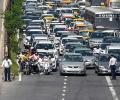
The lockdown in Maharashtra will have a catastrophic impact on April sales, as dealers will not be able to realise the potential of festivities like Ugadi, Gudi Padwa, Baisakhi and Poila Boishakh.
Kinetic Motor's assets bought for Rs 110 crore.
Market leader Maruti Suzuki sold 51,274 units, down 49.61 per cent from the same month last year. Hyundai Motor sold 21,320 units, a decline of 49.25 per cent and Mahindra & Mahindra sold 8,075 units, down 54.54 per cent.
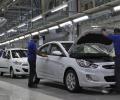
Scooters, once the fastest growing sub-segment, also declined for the second consecutive month in September.
How does the latest offering from the Mahindra stables match up? Read on
After auto components major Bosch Ltd, Sundaram-Clayton, Hero MotoCorp now announce temporary production shut down
Leading carmakers Maruti Suzuki and Hyundai witnessed a double-digit drop in sales in October on account of the global semiconductor shortage impacting production. Kia India, Honda Cars and MG Motor also saw a fall in dispatches last month as compared with October 2020. However, companies like Tata Motors, Mahindra, Nissan and Skoda managed to post positive numbers last month despite the supply chain challenges.

Ford, which had announced to quit the Indian market last year, said it was exploring the possibility of using one of its plants in India to produce electric cars for exports.

Data issued by Siam shows sale of PVs (cars, vans and utility vehicles) grew 14.3 per cent to 275,417 vehicles.


...because their design did not get a thumbs up from motorcycling enthusiasts here
Vehicle prices have gone up as manufacturers gear up for the transition to stricter emission norm BS-VI from BS-IV beginning April 1.

Domestic passenger vehicle sales declined 0.84 per cent to 2,63,773 units in November from 2,66,000 units in the year-ago period. Motorcycle sales, too, declined 14.87 per cent to 8,93,538 units. Vehicle sales across categories registered a decline of 12.05 per cent to 17,92,415 units from 20,38,007 units in November 2018.

Passenger vehicle sales continue to drop in June; Maruti, Hyundai, Tata Motors, Toyota witness decline. Mahindra & Mahindra, however, reported a 4 per cent growth.

In the two-wheeler segment, Bajaj Auto reported 31 per cent jump in total sales at 357,883 units in February against 273,513 units in the same month last year.
Auto majors like Honda, Hero MotoCorp, Mahindra, Vespa, Yamaha and TVS have launched a slew of products to take advantage of the rising interest in scooters in India.

'Just because of my background and poor academic qualifications, most people disbelieve what I have done.'
